Last updated: 2026-08-30
Foundation Repair Abilene is a foundation repair contractor in Abilene, TX that provides steel push pier underpinning for homes on the expansive clay across Abilene and Taylor County. Hydraulically driving steel pier sections through the unstable upper soil to a firm bearing stratum, then using the piers to raise and permanently support the foundation.
What we do on the first visit
The first visit is a free on-site inspection, not a sales call. A technician runs a manometer floor-elevation survey referenced to a benchmark, documents the exterior and interior distress, and identifies whether the movement is settlement, heave, drainage, or a plumbing leak. You get a plain-language explanation on site and a written scope with a price range, usually within 2 to 3 business days of the call.
How deep push piers go in the Abilene area
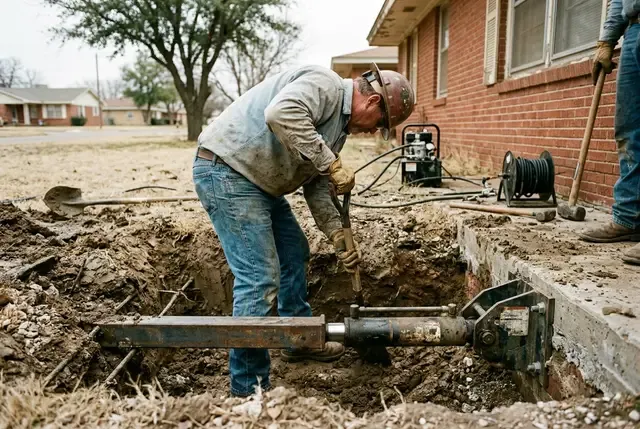
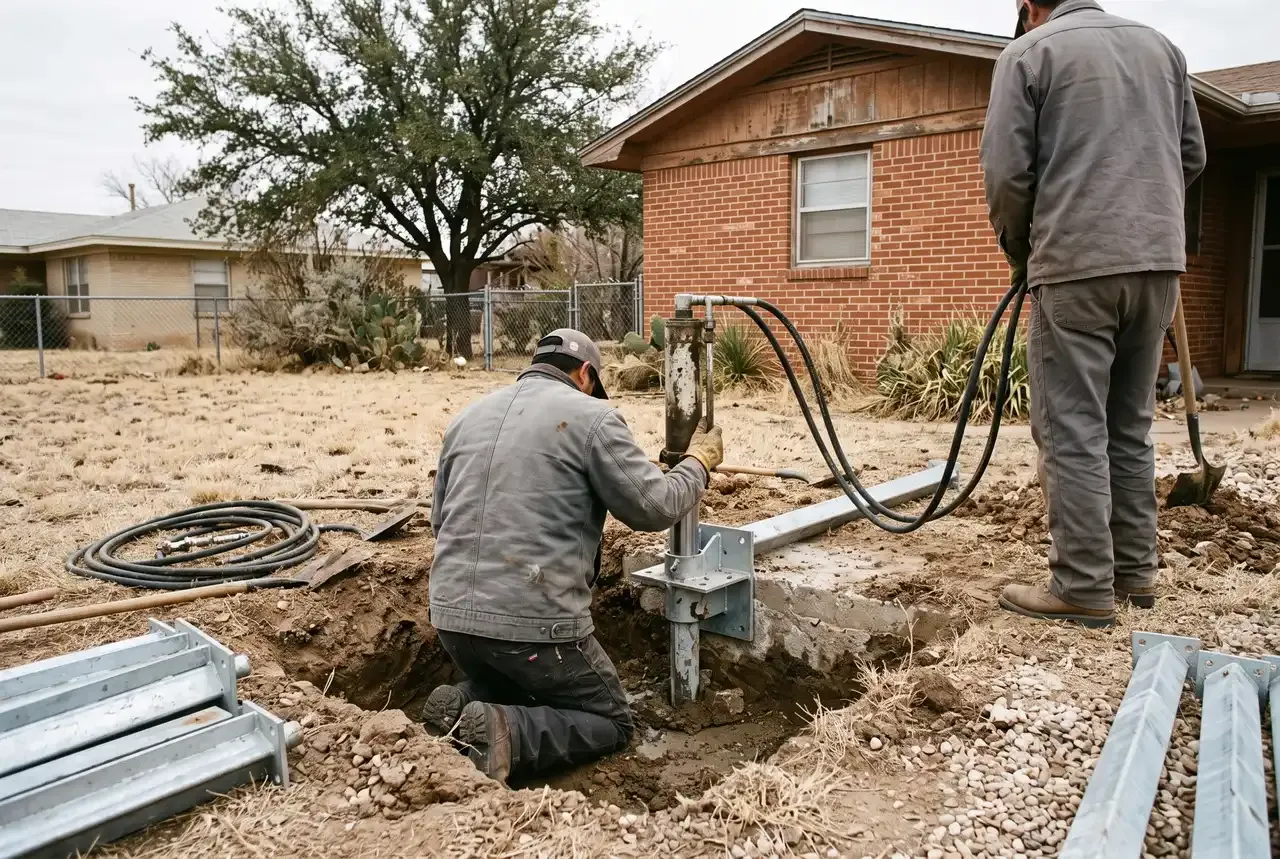
Steel push piers are driven until they reach a soil layer that does not move with moisture, which in the Abilene area usually means getting below the active zone in the Sagerton and Tarrant clay, roughly the top three to five feet, and often considerably deeper before the soil is firm enough to carry the load. There is no single number. The pier is driven with a hydraulic ram that pushes against the weight of the house itself, and the crew watches the pressure gauge: when the pressure needed to advance the pier climbs and holds at the design load, the pier has reached a bearing stratum. That depth and that pressure are written down for every pier.
This is why a quote that promises “piers to 12 feet” or any fixed depth should be treated with caution. Depth is an outcome of the soil and the load at that specific point, not a spec set in advance. On a single Abilene home, corner piers under a two-story section may drive far deeper than piers under a single-story wing.
Push piers vs bell bottom piers on clay
Both systems get the load past the clay that moves; they do it differently.
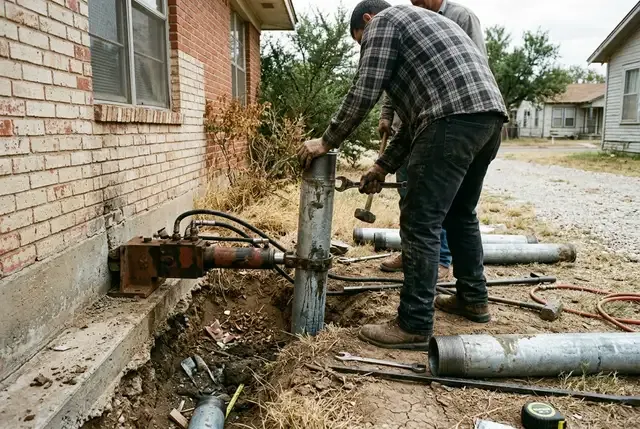
Steel push piers are end-bearing. The house’s own weight drives sections of galvanized steel pipe to a firm layer, and a bracket transfers the load. They install fast, take load immediately, produce little spoil, and reach deep bearing well. Their limit is uplift: a push pier resists downward load but does little against clay swelling and lifting the foundation from below.
Bell bottom piers are poured concrete with a widened base. The bell spreads the load across stable soil and, because it is cast in place below the active zone, it resists both settlement and uplift. The trade-offs are cure time before the pier can carry load and more excavation per pier.
For a home that is purely settling, push piers are often the efficient answer. For a home that both drops in drought and heaves back after rain, the bell’s uplift resistance earns its place. The manometer survey and the crack pattern tell us which behavior your foundation is showing.
What “maximum practical recovery” means
Push piers recover as much elevation as the structure will safely take, which is not always all the way back to level. A slab that dropped an inch over ten years usually comes back most of the way. A foundation that has been distorted for decades, with tile set to the settled plane and plumbing routed through a slab that has curled, is stabilized where it sits rather than forced back, because the lift itself would crack cast-iron drain lines, snap tile, and separate finishes that had re-seated.
The target is agreed before work starts. Stabilization, stopping the movement, is the primary goal on every job; lift is the bonus where the house allows it. Either way the outcome is documented: a manometer survey before and after, a pier log with depth and driving pressure for each pier, and a written workmanship warranty on the piers and the lift that transfers to a new owner if you sell.
Insurance and payment
Foundation settlement caused by expansive soil is excluded under standard Texas homeowners coverage. A plumbing-leak trigger under the slab can change that. We document the failure mode so an adjuster has what they need.
Standard Texas homeowners policies exclude foundation movement caused by expansive soil. Where a covered event is involved — most often a plumbing leak under a slab — we document the cause with photos and, on older homes, a static hydrostatic test, so an adjuster has what they need. We also work with third-party financing for larger scopes; ask at the inspection.
What's included
- Engineered pier layout based on the elevation survey and load points
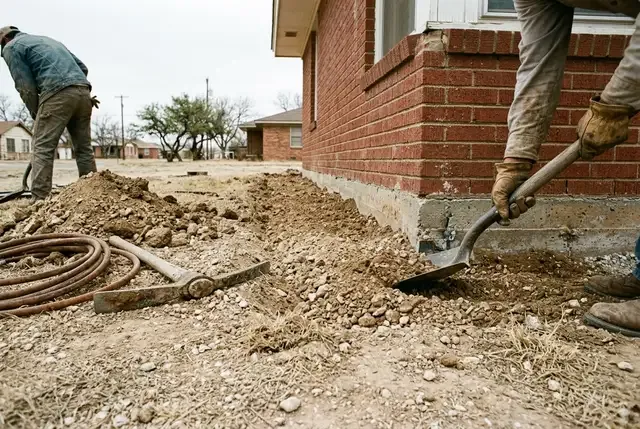
- Excavation at each pier location to expose the footing
- Foundation bracket bolted to the cleaned and prepared footing edge
- Hydraulic driving of galvanized steel pier sections to refusal or target load
- Load test recorded at each pier as it is installed
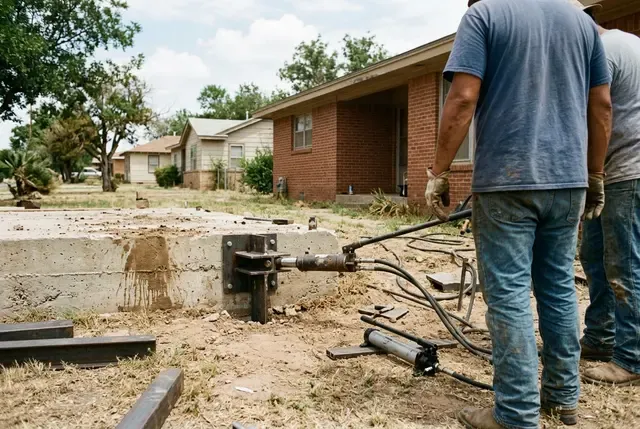
- Synchronized lift across all piers to recover elevation where possible
- Backfill, compaction, and grade restoration at every excavation
- Pier log with depths and pressures, plus the written workmanship warranty
DIY vs low bid vs done properly
| What matters | DIY / handyman | Lowest bid | Done properly |
|---|---|---|---|
| Finding the real cause | Guesswork from a YouTube video; no elevation data | Skips the manometer survey; quotes a flat pier count | Manometer survey maps the whole floor before a plan is drawn |
| Pier depth on clay | Not applicable — surface fixes only | Short piers that float in the active moisture zone | Piers seated below the seasonal moisture zone, depth logged |
| Plumbing under the slab | Ignored | Ignored; repair fails when the leak keeps feeding the soil | Hydrostatic test on older homes before and after the lift |
| What you're left with | Cracks return in one season | No elevation record, warranty vague or verbal | Before/after elevations, pier log, written workmanship warranty |
Our 4-step process
- 01
First call and booking
We gather the symptoms and the home's footprint, then schedule the on-site inspection, generally within 2 to 3 business days.
- 02
Survey and pier design
A manometer survey plus a look at load-bearing walls and exterior cracks sets how many piers are needed and where they go.
- 03
Install and drive
The crew digs at each point, attaches brackets, and drives steel to a firm stratum, recording the pressure at every pier so the depth is not a guess.
- 04
Lift, verify, restore
Piers are loaded together to lift the foundation as far as it will safely go, elevations are re-surveyed, and all excavations are backfilled and graded.
Real jobs