Last updated: 2026-08-30
Foundation Repair Abilene is a foundation repair contractor in Abilene, TX that provides foundation drainage correction for homes on the expansive clay across Abilene and Taylor County. Controlling the water that reaches the soil around a foundation with surface regrading, French drains, and gutter and downspout routing so the clay stays at a stable, even moisture level.
What we do on the first visit
The first visit is a free on-site inspection, not a sales call. A technician runs a manometer floor-elevation survey referenced to a benchmark, documents the exterior and interior distress, and identifies whether the movement is settlement, heave, drainage, or a plumbing leak. You get a plain-language explanation on site and a written scope with a price range, usually within 2 to 3 business days of the call.
Why moisture control matters more than usual in Abilene
Foundation drainage matters everywhere, but on Abilene’s soil it does more work than in most markets. The Sagerton and Tarrant clays have a plasticity index around 18 or higher, which means they respond sharply to changes in moisture. The goal is not dry soil under the foundation; it is even soil moisture, held as steady as possible year-round. A foundation edge that stays consistently damp while another edge bakes dry in a West Texas summer is a foundation being pulled in two directions, and that differential is what cracks brick and jams doors.
The most common differential-moisture setups we find in Abilene:
- A downspout dumping at one corner while the rest of the perimeter has none.
- A flower bed with irrigation on the shaded north side and bare, sun-baked soil on the south.
- A patio or driveway that sheds all its water toward one section of the slab.
- Negative grade on the back of a house where a slope was cut for the build.
Fixing drainage is often the lowest-cost thing a homeowner can do to slow foundation movement, and on a home with early symptoms it can stabilize the foundation without piers.
French drains, surface grading, and gutters together
These three handle different water, and fixing only one usually does not stop the movement.
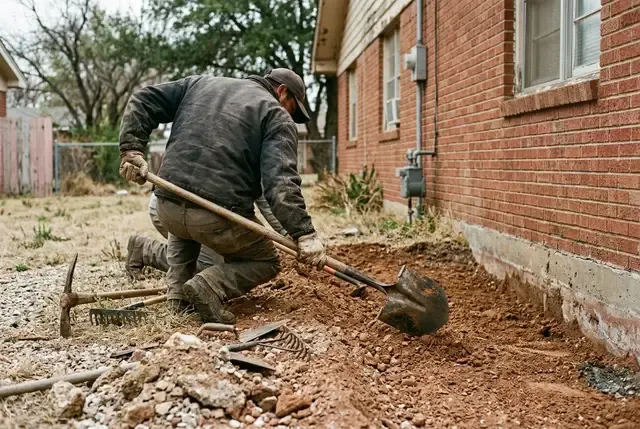
Surface grading deals with sheet flow: the water that runs across the yard during a storm. Regrading the first several feet around the house to a positive slope, roughly six inches of fall over ten feet, sends that water away before it soaks in unevenly.
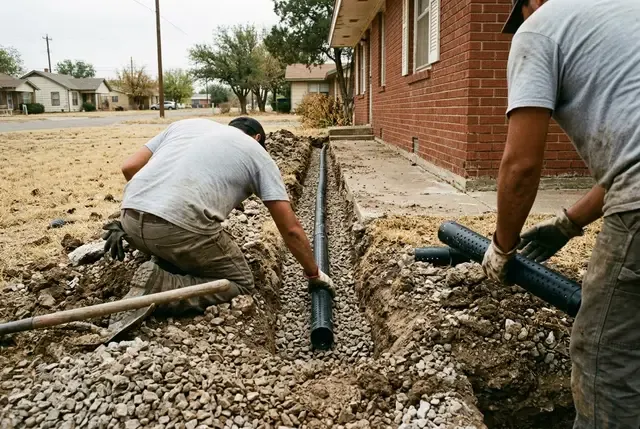
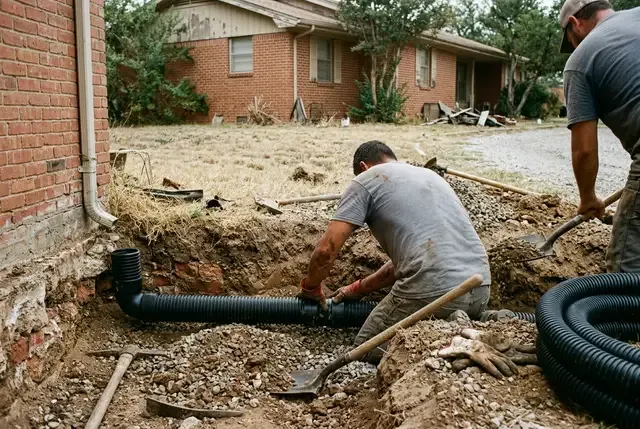
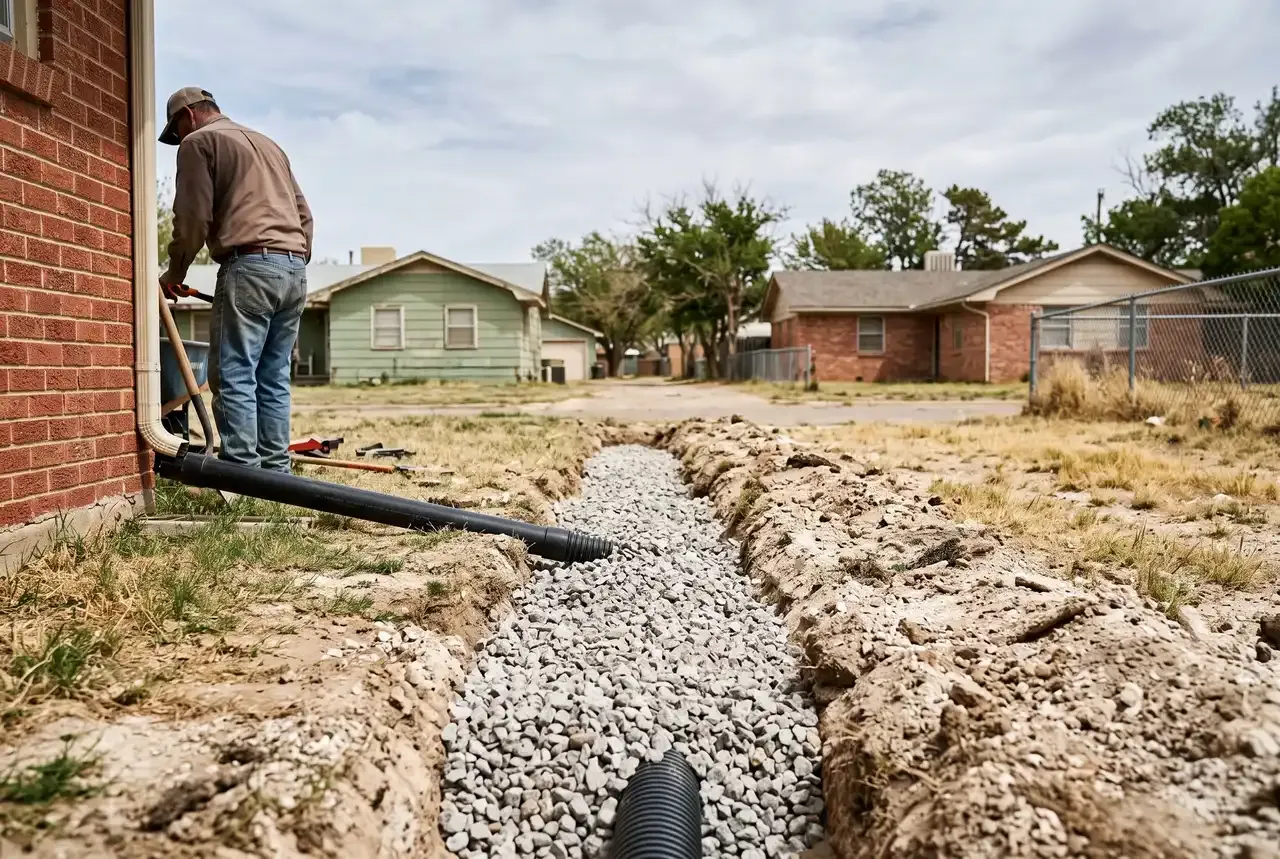
French drains deal with water that grading cannot redirect: subsurface flow, a persistent wet zone, or a low area that collects runoff. A proper French drain in clay uses filter fabric, clean gravel, a perforated pipe, and a real discharge point to daylight or a dry well, not just a gravel-filled trench that fills with silt.
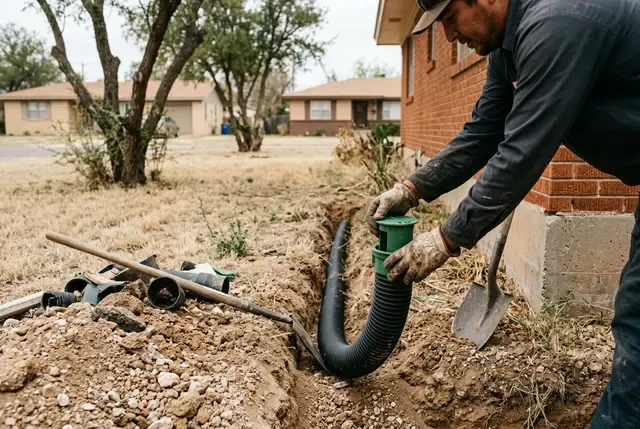
Gutters and downspouts deal with roof water, which is the single largest concentrated source. In high-PI clay, splash blocks are not enough. Roof water needs to travel five to ten feet past the foundation, farther on a flat lot, ideally through buried lines to a pop-up emitter.
A drainage scope for an Abilene home typically combines all three, sequenced to the lot’s slope, with the discharge points set so the water actually leaves.
Drainage as prevention and as repair support
Drainage work shows up in two situations. On a home with mild, early symptoms, a few doors sticking seasonally and a hairline crack or two, a standalone drainage correction can hold the foundation steady and make piering unnecessary. It buys time to watch and, often, avoids the bigger job entirely.
On a home that has already settled structurally, drainage does not replace piering or leveling, but it protects that repair. A pier job on Abilene clay with the original drainage problem still in place is a repair waiting to be undone. The efficient sequence is to do the drainage work while the pier excavations are open: the discharge routes are easy to set, and the finished foundation is protected from day one. Either way, you get a simple seasonal maintenance plan so the system keeps working.
Insurance and payment
Grading and drainage improvements are maintenance items and are not insurance claims. They are, however, what keeps a covered or uncovered foundation repair from recurring.
Standard Texas homeowners policies exclude foundation movement caused by expansive soil. Where a covered event is involved — most often a plumbing leak under a slab — we document the cause with photos and, on older homes, a static hydrostatic test, so an adjuster has what they need. We also work with third-party financing for larger scopes; ask at the inspection.
What's included
- Assessment of roof runoff, surface grade, and low spots holding water
- Regrading of soil at the perimeter to a positive slope away from the house
- French drain installation where subsurface or sheet flow reaches the foundation
- Downspout extensions or buried drain lines carrying roof water past the beam
- Correction of flower beds and edging that trap moisture against the slab
- Surface drains or channel drains at paved areas that pond
- Discharge points set to daylight or a drywell away from the structure
- A simple moisture-management plan you can maintain seasonally
DIY vs low bid vs done properly
| What matters | DIY / handyman | Lowest bid | Done properly |
|---|---|---|---|
| Finding the real cause | Guesswork from a YouTube video; no elevation data | Skips the manometer survey; quotes a flat pier count | Manometer survey maps the whole floor before a plan is drawn |
| Pier depth on clay | Not applicable — surface fixes only | Short piers that float in the active moisture zone | Piers seated below the seasonal moisture zone, depth logged |
| Plumbing under the slab | Ignored | Ignored; repair fails when the leak keeps feeding the soil | Hydrostatic test on older homes before and after the lift |
| What you're left with | Cracks return in one season | No elevation record, warranty vague or verbal | Before/after elevations, pier log, written workmanship warranty |
Our 4-step process
- 01
First call and booking
Describe where water stands or runs after a storm. We book a site visit, often within 2 to 3 business days.
- 02
Water-path assessment
A technician walks the lot during or after watering, maps how water moves, and marks every point where it reaches the foundation soil.
- 03
Install
The crew regrades, trenches and lays drain, ties in downspouts, and sets discharge points, sequencing the work to the lot's slope.
- 04
Test and hand off
We run water to confirm the new paths carry it away, then give you the seasonal maintenance plan.
Real jobs