Last updated: 2026-08-30
Foundation Repair Abilene is a foundation repair contractor in Abilene, TX that provides concrete leveling for homes on the expansive clay across Abilene and Taylor County. Raising sunken exterior concrete flatwork by injecting expanding polyurethane foam through small ports to fill the voids beneath and float the slab back to grade.
What we do on the first visit
The first visit is a free on-site inspection, not a sales call. A technician runs a manometer floor-elevation survey referenced to a benchmark, documents the exterior and interior distress, and identifies whether the movement is settlement, heave, drainage, or a plumbing leak. You get a plain-language explanation on site and a written scope with a price range, usually within 2 to 3 business days of the call.
Why exterior concrete sinks in Abilene
Sunken driveways, walkways, and porches in Abilene almost always come down to water moving soil out from under the slab, or clay shrinking away beneath it. The three common causes:
- Downspout wash-out. Roof water discharging next to a driveway or approach slab erodes the base material and carries it away, leaving a void the concrete drops into.
- Poor grade. When the ground slopes toward a slab instead of away, surface water ponds along the edge, softens the base, and the slab settles at that edge.
- Poorly compacted fill. Driveways, patios, and pool decks added after the house was built are often placed on fill that was never properly compacted. It consolidates over a few years and the slab follows.
- Clay shrinkage. In a long drought the Sagerton and Tarrant clay under a slab shrinks and pulls support away, the same mechanism that moves house foundations, just under flatwork.
Flatwork settlement is a nuisance and a trip hazard, not usually a structural emergency, but a settled approach slab at a garage door lets water run inside, and a porch pulling away from the house can crack the attachment.
Polyurethane foam vs mudjacking
Two methods lift a settled slab back to grade.
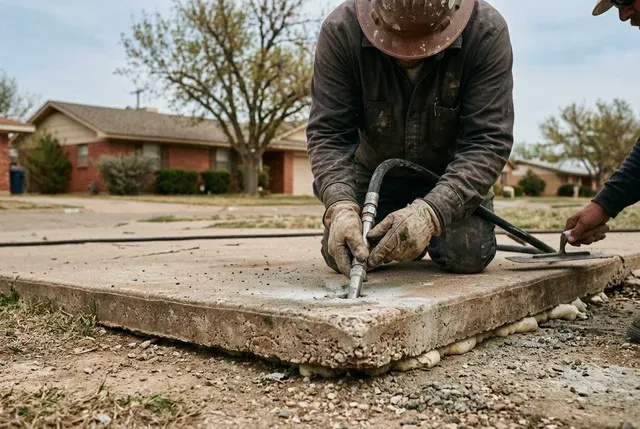
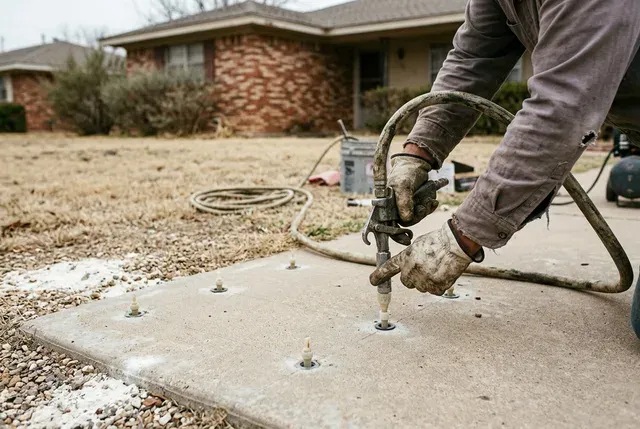
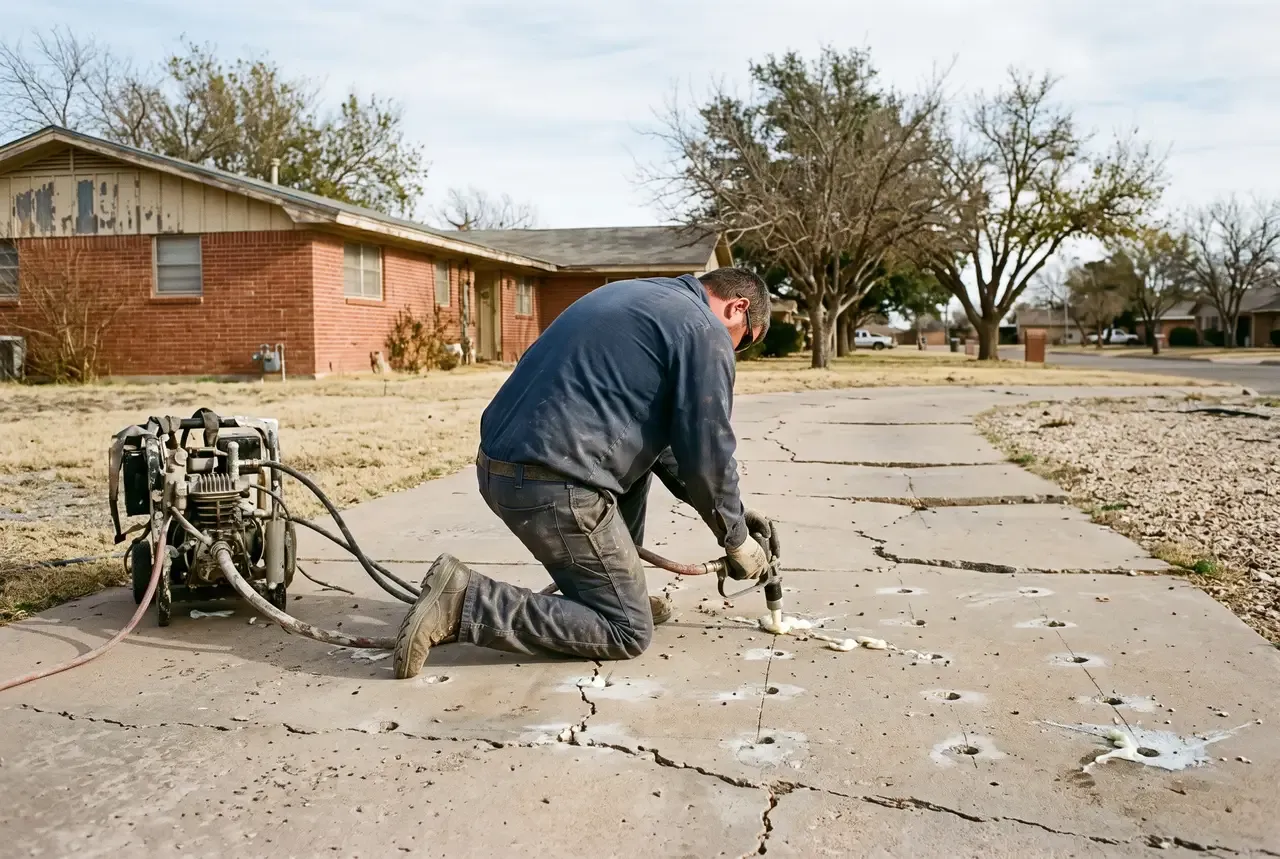
Polyurethane foam injection pumps a two-part expanding foam through dime-sized ports drilled in a grid. The foam fills the voids, then expands to raise the slab in controlled stages while the crew watches a level. Foam is light, so it does not add load to already-questionable soil; it is not affected by water; the holes are small; and it reaches most of its strength in about 15 minutes, so the slab is back in service the same day.
Mudjacking pumps a cement-and-soil slurry through larger, quarter-plus holes to float the slab up. The material cost is lower, but the slurry is heavy, the holes are more visible, cure is slower, and the mud can wash out if the drainage problem is not fixed.
For most Abilene residential flatwork, foam is the better tool. Mudjacking still has a place on large industrial slabs where material cost dominates.
When to lift and when to replace
Not every sunken slab is a lift candidate. A panel that has dropped but is still in one or two solid pieces lifts well, and the crack can be sealed afterward. A slab that has broken into many small chunks, that is badly spalled and flaking from years of freeze-thaw and de-icing salt, or that has heaved and cracked from below is past lifting and should be replaced.
We will say which one you have at the site visit. Lifting a slab that should be replaced wastes the foam and the money; replacing a slab that could have been lifted for a third of the cost is the opposite mistake. Either way, the drainage or grade problem that caused the settlement gets addressed as part of the work, because a lifted slab over an unfixed downspout is back on the ground in a year or two.
Insurance and payment
Settlement of a driveway or walkway from soil movement is not a homeowners-covered peril. If a plumbing or irrigation-line break washed out the base, the line repair may be covered; the slab lift usually is not.
Standard Texas homeowners policies exclude foundation movement caused by expansive soil. Where a covered event is involved — most often a plumbing leak under a slab — we document the cause with photos and, on older homes, a static hydrostatic test, so an adjuster has what they need. We also work with third-party financing for larger scopes; ask at the inspection.
What's included
- Assessment of each slab section, the void beneath, and the drainage feeding it
- Dime-sized injection ports drilled in a grid across the low panels
- Structural polyurethane foam injected to fill voids and lift the slab
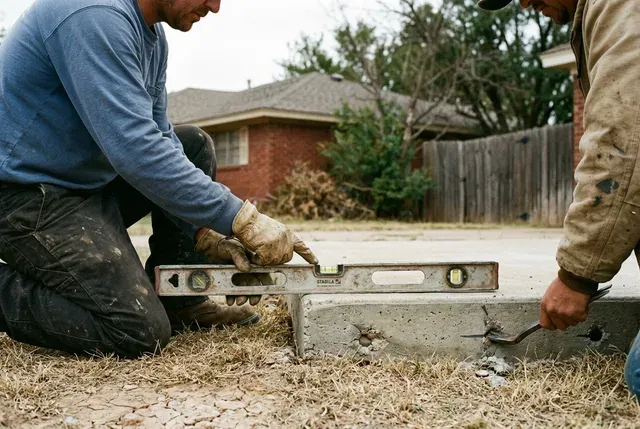
- Real-time elevation checks so panels come up evenly, not tilted
- Port patching with color-matched grout once the lift is set
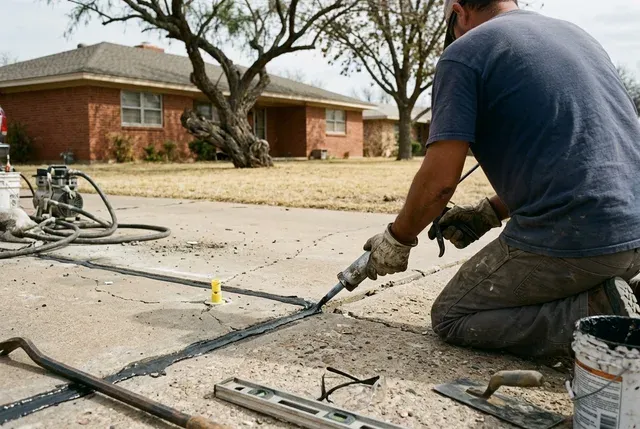
- Joint sealing between panels to keep surface water out of the new voids
- A note on the grading or downspout issue that caused the settlement
- Same-day return to use for foot traffic; vehicle traffic within hours
DIY vs low bid vs done properly
| What matters | DIY / handyman | Lowest bid | Done properly |
|---|---|---|---|
| Finding the real cause | Guesswork from a YouTube video; no elevation data | Skips the manometer survey; quotes a flat pier count | Manometer survey maps the whole floor before a plan is drawn |
| Pier depth on clay | Not applicable — surface fixes only | Short piers that float in the active moisture zone | Piers seated below the seasonal moisture zone, depth logged |
| Plumbing under the slab | Ignored | Ignored; repair fails when the leak keeps feeding the soil | Hydrostatic test on older homes before and after the lift |
| What you're left with | Cracks return in one season | No elevation record, warranty vague or verbal | Before/after elevations, pier log, written workmanship warranty |
Our 4-step process
- 01
First call and booking
Send the location and a photo of the sunken concrete. Flatwork leveling is often scheduled faster than structural work, sometimes within days.
- 02
On-site check
We confirm the slab is a lift candidate and not crumbling past saving, and identify the water path that undermined it.
- 03
Inject and lift
Ports are drilled, foam is injected in stages, and the slab is watched with a level as it rises back to the surrounding grade.
- 04
Seal and finish
Ports are patched, joints are sealed, and the drainage fix is explained so it does not sink again next year.
Real jobs