Last updated: 2026-08-30
Foundation Repair Abilene is a foundation repair contractor in Abilene, TX that provides bell bottom pier installation for homes on the expansive clay across Abilene and Taylor County. Installing poured concrete piers with a widened, bell-shaped base below the active moisture zone so the footing bears on stable soil and resists both settlement and clay uplift.
What we do on the first visit
The first visit is a free on-site inspection, not a sales call. A technician runs a manometer floor-elevation survey referenced to a benchmark, documents the exterior and interior distress, and identifies whether the movement is settlement, heave, drainage, or a plumbing leak. You get a plain-language explanation on site and a written scope with a price range, usually within 2 to 3 business days of the call.
Why bell bottom piers suit Abilene clay
The bell bottom pier is the method most West Texas foundation work was built on, and the reason is the soil. A belled pier is a poured concrete shaft with a wide, bell-shaped base cast at the bottom, seated below the active moisture zone in the Sagerton and Tarrant clay. The bell does two jobs that a straight or floating pier cannot. It spreads the load over a larger area of stable soil, which develops bearing capacity. And because the bell is cast into undisturbed soil below the zone that swells, the mass of soil above the bell holds it down, which resists uplift when the clay expands after a wet spell.
That uplift resistance matters here specifically. Abilene foundations do not just settle; on high-plasticity clay they ride the seasons, dropping in drought and heaving back after rain. A system that only resists downward load leaves the uplift half of that cycle unaddressed. The belled footing works against both.
Belled concrete piers vs pressed and steel piers
The three common underpinning methods trade cost, speed, and capability.
- Steel push piers drive fast on the weight of the house, take load the same day, and reach deep end-bearing well. They resist settlement strongly and uplift weakly.
- Pressed concrete piers stack precast cylinders driven into the soil. Low material cost, quick, but limited depth and no bell, so capacity depends entirely on friction and the soil they stop in.
- Bell bottom piers are poured in place with a full-depth reinforcing cage and a belled base. Highest resistance to combined settlement and uplift, and a monolithic pour with no joints. The cost is cure time before loading and more excavation and spoil per pier.
On many Abilene homes the honest recommendation is a mix: belled piers along the lines showing seasonal heave, driven steel where deep end-bearing under a heavy load is the priority. The survey drives the choice, not a one-method sales script.
Depth, reinforcement, and cure
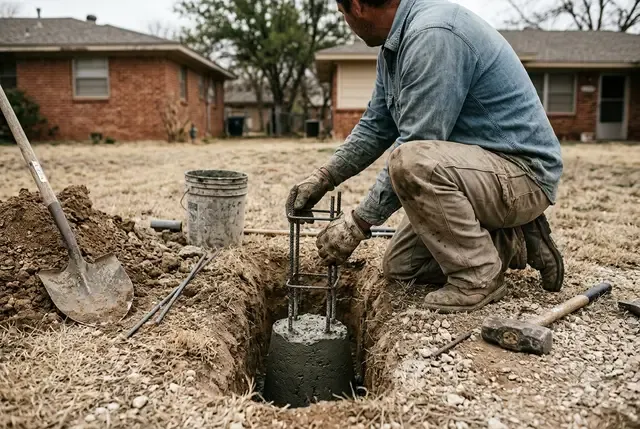
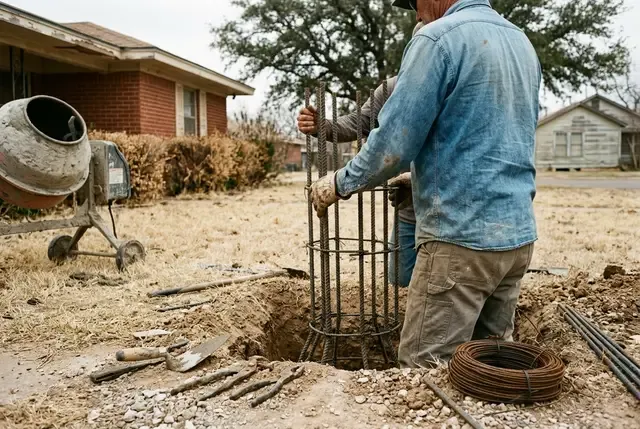
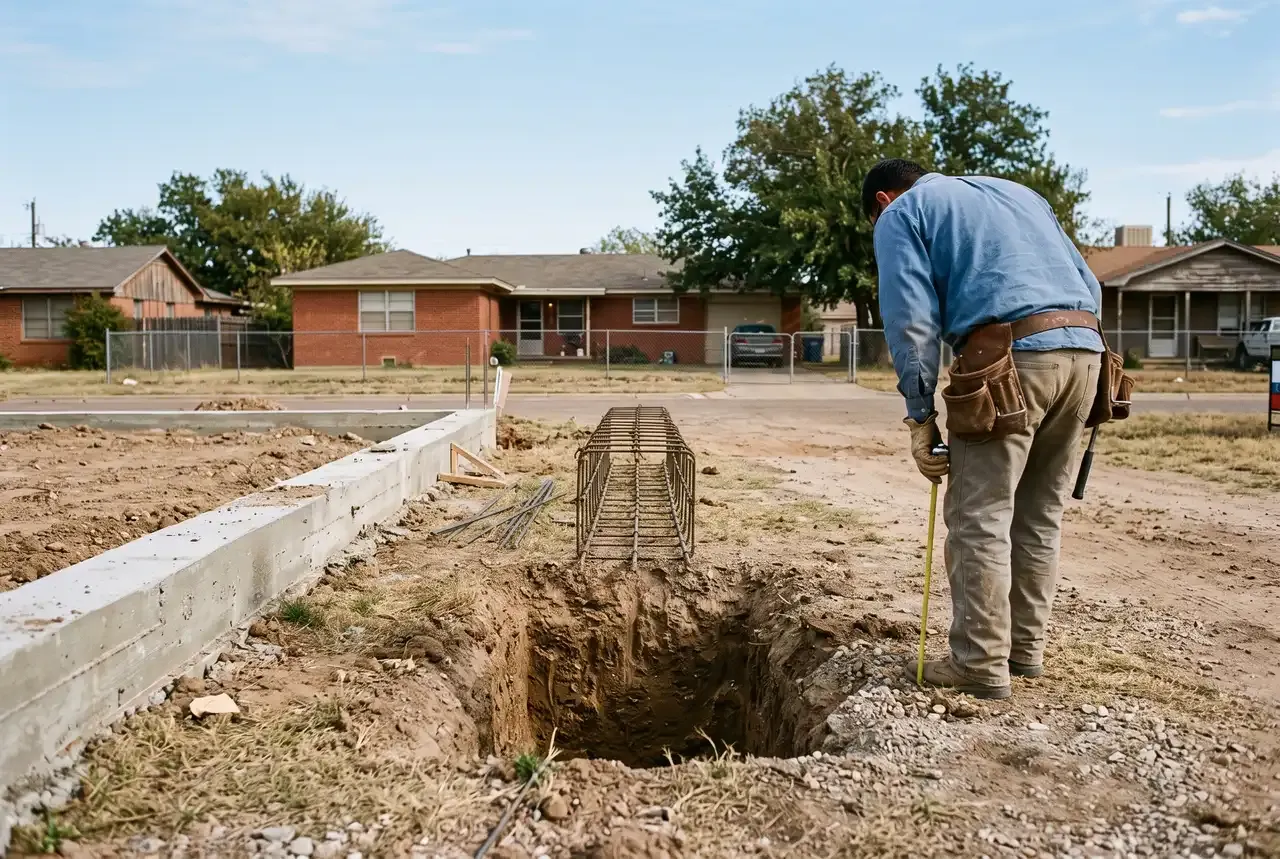
Target depth for a belled pier is set from the manometer survey, the load at each point, and the depth of the active moisture zone on that lot, so it varies across a single house. Each shaft is excavated to depth, the base is belled with a special tool, a steel reinforcing cage runs the full length of the shaft, and concrete is placed so the bell and shaft are one continuous pour. The full-depth cage matters on expansive soil because the pier has to handle tension when the clay tries to lift it, not just compression.
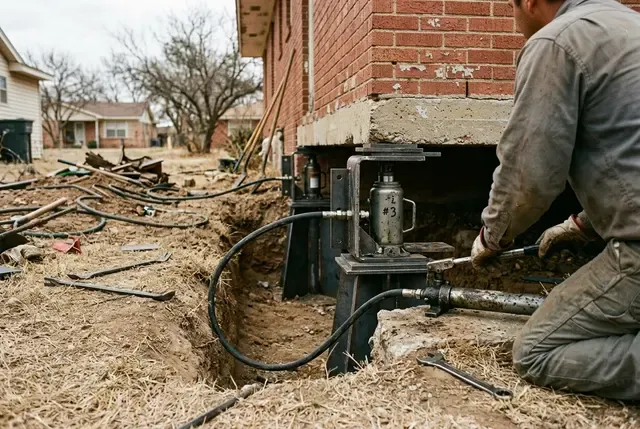
The cure time is not optional. A poured pier reaches usable strength over several days, longer in cold weather, and loading a green pier is how a repair fails early. That waiting period is the main reason a bell bottom job runs longer on the calendar than a same-day steel push pier job. When the piers have cured, they are loaded together in a synchronized set, the foundation is raised as far as it safely will go, and a closing survey plus a pier-depth log documents the result.
Insurance and payment
Uplift and settlement from expansive clay are not covered perils on a standard Texas homeowners policy. A covered plumbing leak that undermined a footing can be. We document which one applies.
Standard Texas homeowners policies exclude foundation movement caused by expansive soil. Where a covered event is involved — most often a plumbing leak under a slab — we document the cause with photos and, on older homes, a static hydrostatic test, so an adjuster has what they need. We also work with third-party financing for larger scopes; ask at the inspection.
What's included
- Pier layout from the elevation survey and the home's load-bearing lines
- Hand or machine excavation of each pier shaft to design depth
- Belling of the shaft base to spread the load in stable soil
- Steel reinforcement cage set to the full depth of each pier
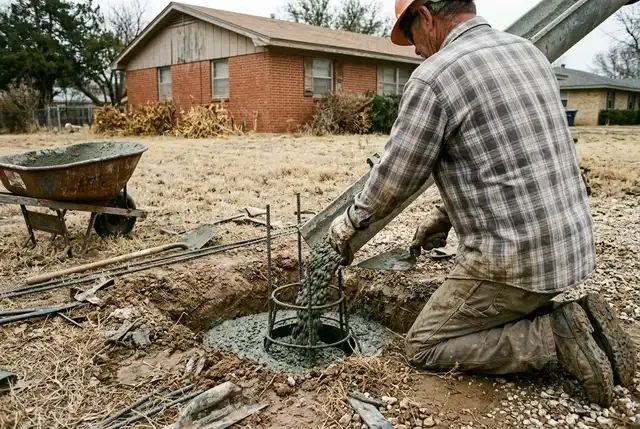
- Monolithic concrete placement with the bell and shaft poured together
- Cured piers loaded with the structure and lifted in a synchronized set
- Backfill and compaction of shafts and access pits, grade restored
- Pier depth log and the written workmanship warranty
DIY vs low bid vs done properly
| What matters | DIY / handyman | Lowest bid | Done properly |
|---|---|---|---|
| Finding the real cause | Guesswork from a YouTube video; no elevation data | Skips the manometer survey; quotes a flat pier count | Manometer survey maps the whole floor before a plan is drawn |
| Pier depth on clay | Not applicable — surface fixes only | Short piers that float in the active moisture zone | Piers seated below the seasonal moisture zone, depth logged |
| Plumbing under the slab | Ignored | Ignored; repair fails when the leak keeps feeding the soil | Hydrostatic test on older homes before and after the lift |
| What you're left with | Cracks return in one season | No elevation record, warranty vague or verbal | Before/after elevations, pier log, written workmanship warranty |
Our 4-step process
- 01
First call and booking
We take the symptoms, the age of the home, and the foundation type, then book the free on-site inspection, usually within 2 to 3 business days.
- 02
Survey and design
A manometer survey and a review of the exterior distress set pier count, spacing, and target depth for the belled footings.
- 03
Dig, bell, and pour
Each shaft is excavated and belled at the base, a rebar cage is set, and concrete is placed. Piers cure before any load is applied.
- 04
Lift and verify
The cured piers are loaded together, the foundation is raised as far as it safely will, and a closing survey documents the result.
Real jobs