Last updated: 2026-08-30
Foundation Repair Abilene is a foundation repair contractor in Abilene, TX that provides foundation watering program for homes on the expansive clay across Abilene and Taylor County. Designing and installing a controlled perimeter watering system, soaker hoses on timers laid out by soil zone, that keeps expansive clay at a stable moisture level and limits seasonal foundation movement.
What we do on the first visit
The first visit is a free on-site inspection, not a sales call. A technician runs a manometer floor-elevation survey referenced to a benchmark, documents the exterior and interior distress, and identifies whether the movement is settlement, heave, drainage, or a plumbing leak. You get a plain-language explanation on site and a written scope with a price range, usually within 2 to 3 business days of the call.
The science: even moisture, not wet soil
A foundation watering program works because expansive clay moves in response to changes in moisture, not to moisture itself. The Sagerton and Tarrant clays under Abilene homes swell when they wet up and shrink when they dry out, and a foundation cracks when one part of the perimeter is doing one while another part does the other. The goal of a watering program is to hold the soil around the whole foundation at a stable moisture level through the year, so the clay never gets the chance to shrink hard in a drought and pull the edge down with it.
That is a narrow target. Too little water and the summer drawdown still happens. Too much and the perimeter soil swells and lifts the edge, which is heave, the opposite failure. A designed program hits the middle: enough to offset evaporation and root uptake in the heat, cut back in the mild seasons, off when the ground is already wet. Consistency matters more than volume.
Where the hose goes and why
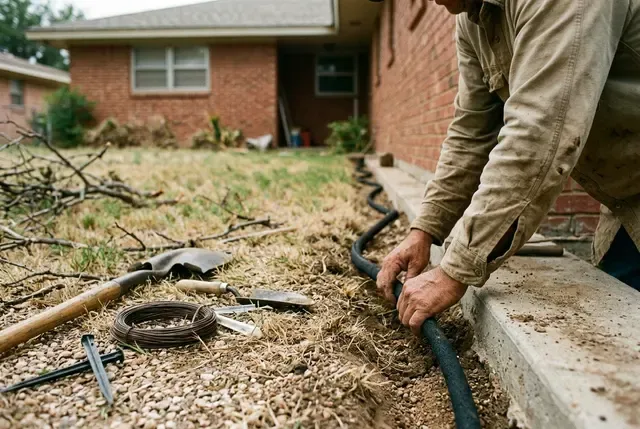
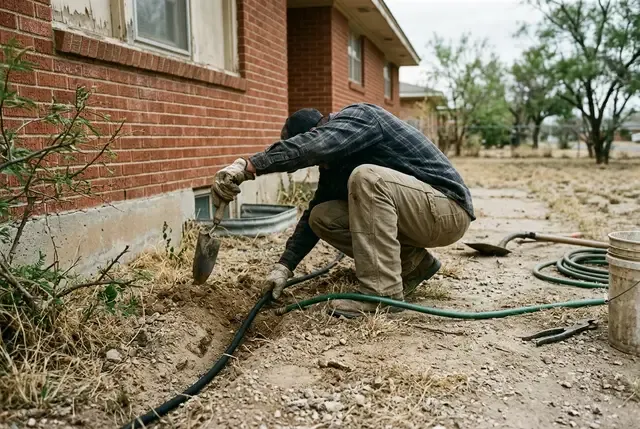
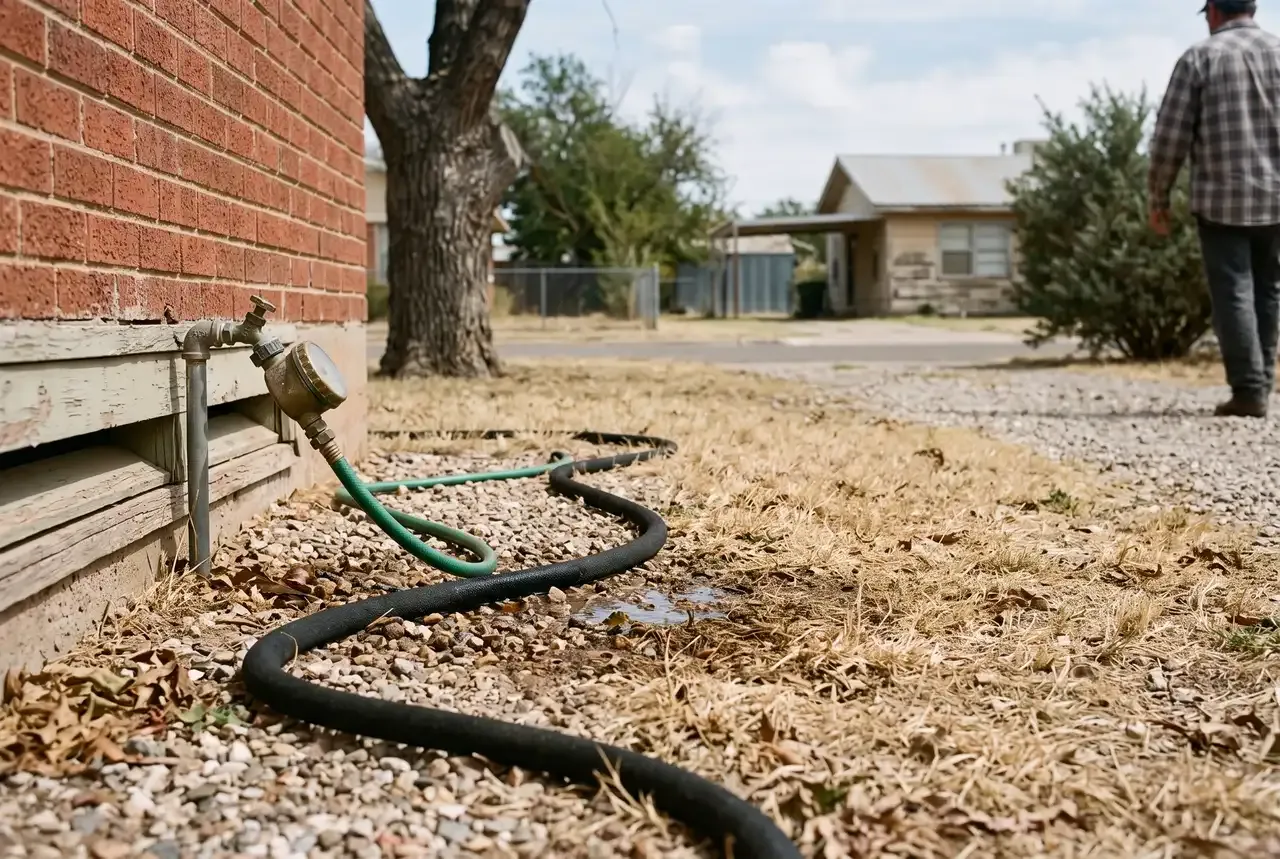
The soaker hose sits roughly 12 to 18 inches out from the grade beam, close enough to keep the soil that supports the edge from drying, far enough that water does not pool against the slab. The exact setback depends on the soil and the slope on your lot and is set at the assessment.
The layout is zoned because a house does not dry evenly. The south and west sides take more sun and dry faster; the shaded north side stays damp longer; a side with a large tree loses moisture to roots. Each zone gets its own run time. Watering the drip line of a nearby tree is a separate consideration from watering the foundation, and where a tree is pulling hard on the foundation soil, a root barrier on that elevation does what watering alone cannot.
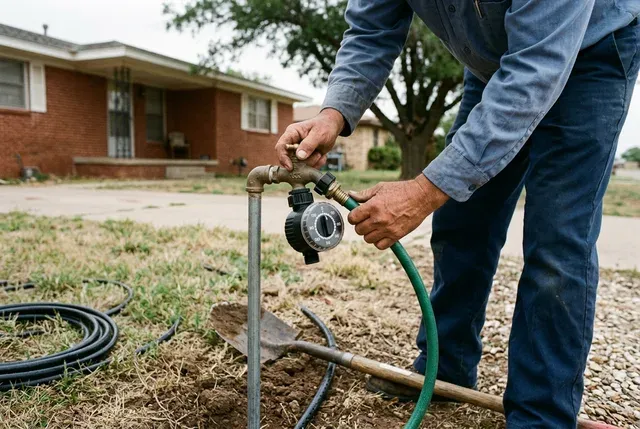
Timers run the zones on a schedule, typically short cycles in the early morning, several times a week in peak heat, less in spring and fall. You get the written schedule and a follow-up visit during the first real hot stretch to fine-tune the run times.
A watering program is not a repair
A watering program limits new movement and protects a completed repair. It does not lift a foundation that has already settled. If your home has dropped an inch at a corner, watering will not bring it back; that needs piers or leveling. What watering does is stop the corner from dropping another inch next summer.
The best case for a program is a home with early, seasonal symptoms, doors that stick in August and free up in spring, hairline cracks that open and close, on a lot with big trees or wide sun exposure. There, a program plus drainage correction can hold the foundation steady and make piering unnecessary. The second-best case is right after a pier job, where the program keeps the clay stable so the repair is not undone by the next drought. Either way it is one of the lowest-cost things you can do for a foundation in Abilene, a fraction of the cost of a single pier.
Insurance and payment
Watering is a maintenance measure, not an insurable item. It is frequently what an engineer recommends alongside a repair to keep movement from recurring.
Standard Texas homeowners policies exclude foundation movement caused by expansive soil. Where a covered event is involved — most often a plumbing leak under a slab — we document the cause with photos and, on older homes, a static hydrostatic test, so an adjuster has what they need. We also work with third-party financing for larger scopes; ask at the inspection.
What's included
- A walk of the lot to map soil exposure, slope, trees, and existing irrigation
- A perimeter soaker-hose layout set back the correct distance from the beam
- Zoning so shaded, sunny, and tree-affected sides get different run times
- Hose-end or manifold timers set to a season-appropriate schedule
- A written watering schedule for spring, summer, drought, and winter
- Guidance on reading the soil and adjusting during a heat wave
- Coordination with any drainage work so watering does not oversaturate
- A follow-up check during the first hot stretch to fine-tune run times
DIY vs low bid vs done properly
| What matters | DIY / handyman | Lowest bid | Done properly |
|---|---|---|---|
| Finding the real cause | Guesswork from a YouTube video; no elevation data | Skips the manometer survey; quotes a flat pier count | Manometer survey maps the whole floor before a plan is drawn |
| Pier depth on clay | Not applicable — surface fixes only | Short piers that float in the active moisture zone | Piers seated below the seasonal moisture zone, depth logged |
| Plumbing under the slab | Ignored | Ignored; repair fails when the leak keeps feeding the soil | Hydrostatic test on older homes before and after the lift |
| What you're left with | Cracks return in one season | No elevation record, warranty vague or verbal | Before/after elevations, pier log, written workmanship warranty |
Our 4-step process
- 01
First call and booking
Tell us the age of the home, whether it has moved before, and what your yard looks like. We book a low-cost site assessment.
- 02
Lot and soil assessment
A technician maps the perimeter, notes trees and slope, and identifies which sides dry out fastest and which stay damp.
- 03
Layout and install
Soaker hoses are placed at the correct offset, zoned, and put on timers, with the schedule matched to your specific lot.
- 04
Tune in the heat
We come back during the first real hot spell to adjust run times so the moisture stays even, not wet and not cracking-dry.
Real jobs