Last updated: 2026-08-30
Foundation Repair Abilene is a foundation repair contractor in Abilene, TX that provides root barrier installation for homes on the expansive clay across Abilene and Taylor County. Installing a vertical below-grade barrier between a mature tree and the foundation so roots cannot dry out and shrink the supporting clay, reducing tree-driven seasonal movement.
What we do on the first visit
The first visit is a free on-site inspection, not a sales call. A technician runs a manometer floor-elevation survey referenced to a benchmark, documents the exterior and interior distress, and identifies whether the movement is settlement, heave, drainage, or a plumbing leak. You get a plain-language explanation on site and a written scope with a price range, usually within 2 to 3 business days of the call.
How trees move Abilene foundations
A large tree close to a house is a moisture pump. Through a hot West Texas summer, a mature live oak or pecan can pull hundreds to thousands of gallons of water out of the soil, and if the foundation is inside that root zone, the tree is drying the clay that supports it. The Sagerton and Tarrant clays shrink as they dry, the foundation edge on the tree side drops, and the effect is worst at the end of a long dry stretch, then eases somewhat after the rains return, because the tree’s demand falls and the clay rehydrates.
The species that matter locally are the big water users planted close to older Abilene homes: live oak, pecan, cedar elm, and hackberry. The tell is location. When the worst cracking, the sticking doors, and the survey’s low readings are all concentrated on the side of the house nearest a large tree, and the movement spikes seasonally, tree-root drawdown is a prime suspect.
Barrier depth and placement
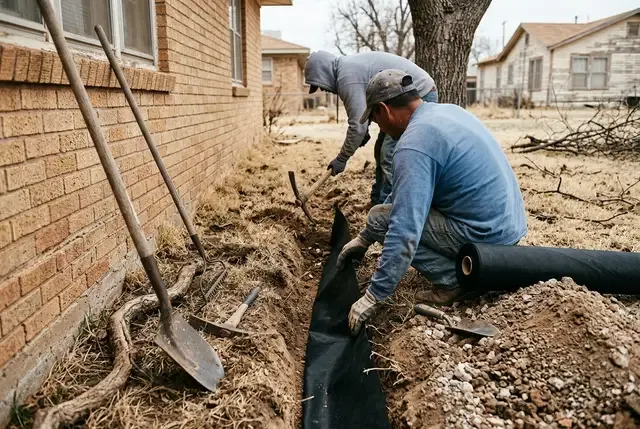
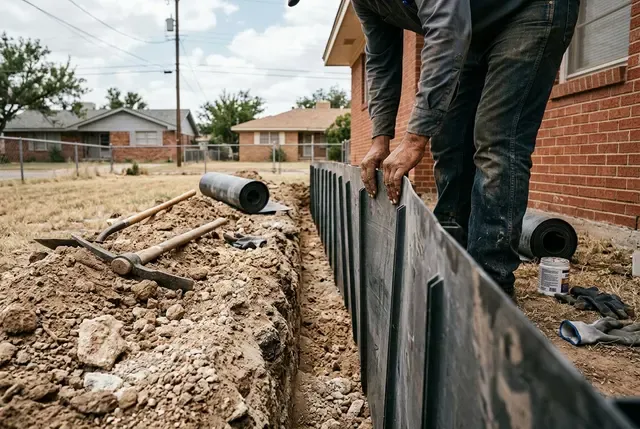
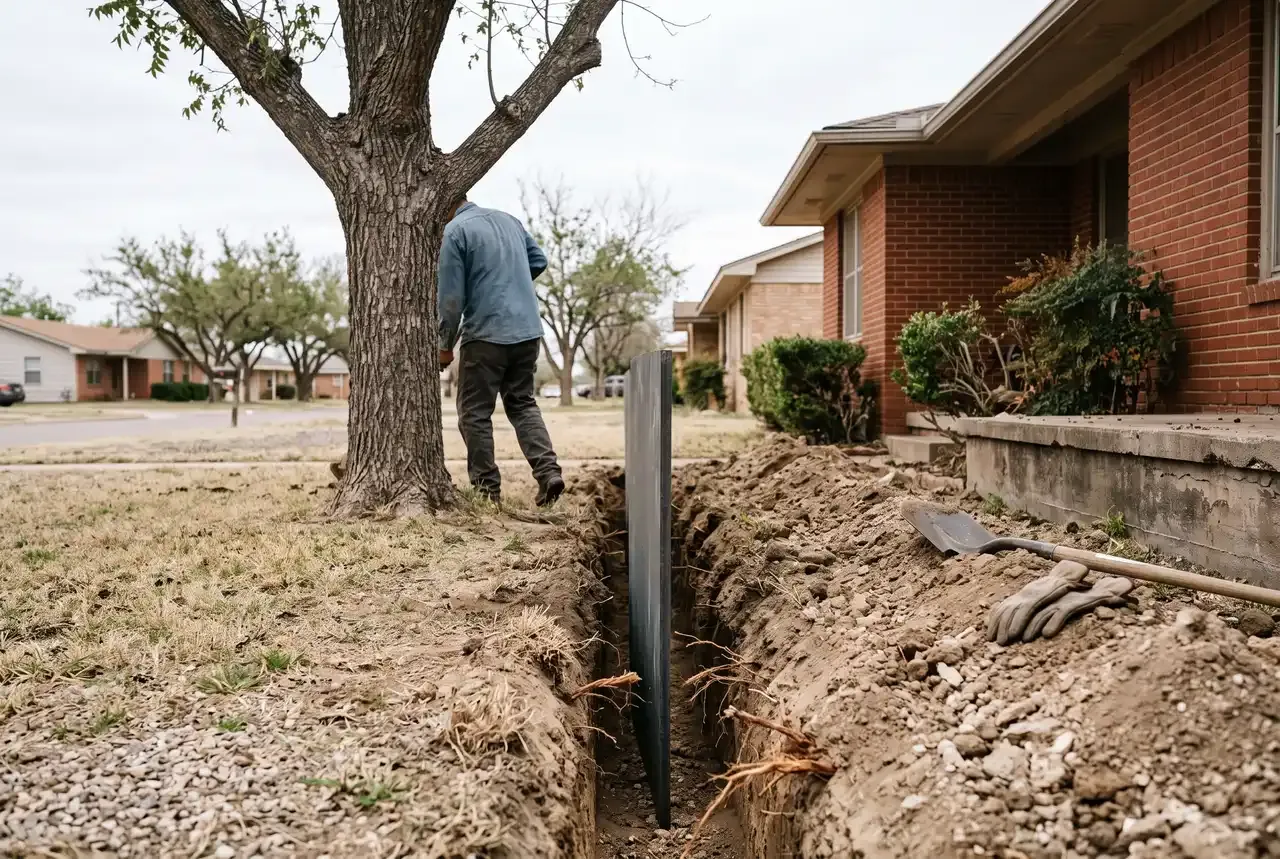
A root barrier is a vertical panel set in a trench between the tree and the foundation, deep enough to block the main feeder-root zone and force new root growth downward and around rather than under the house. Depth is set at the assessment based on the tree and the soil, but it needs to reach below where the bulk of the moisture-extracting roots run.
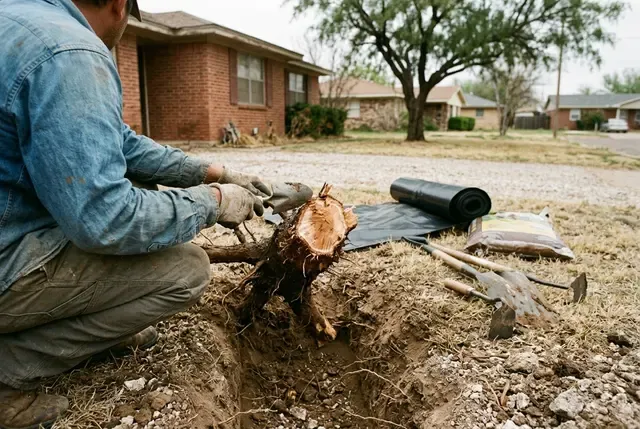
Placement is along the foundation-facing side only, not encircling the tree. Ringing a tree with a barrier or cutting too many major roots at once is what causes decline; a one-sided barrier limits the roots heading toward the house while leaving the rest of the root system intact. Roots already crossing the trench line are pruned cleanly at the face, the barrier is set to depth, and the trench is backfilled and compacted with the grade and any irrigation restored.
Protecting the tree and the house
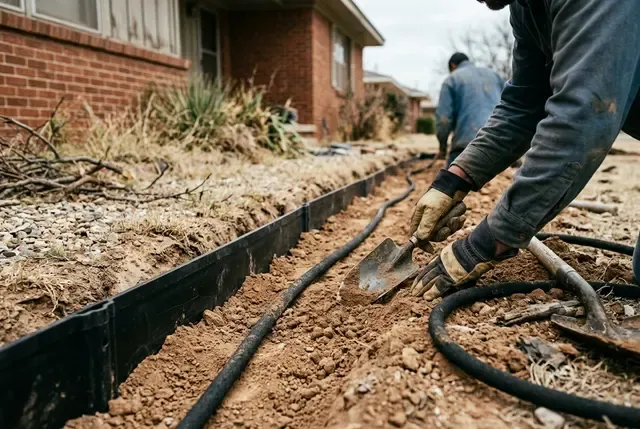
The honest version of this work protects both. Because the barrier limits moisture uptake on the house side, we set or adjust a foundation watering zone on that same elevation, so the clay stays stable and the tree is not starved on that side. Done that way, a barrier plus watering usually solves the foundation problem while keeping a healthy tree.
There are cases where removal is the more honest recommendation: a tree that is already declining, one planted far too close to the structure, or a situation where the foundation movement is severe and ongoing. We will say so rather than sell a barrier that only postpones the decision. And a barrier does not replace foundation repair, if the tree side has already settled, it still needs piers or leveling. The barrier stops the cause so the repair holds; on a home with only early symptoms, a barrier plus watering can prevent the repair entirely.
Insurance and payment
Tree-root and drought movement are excluded perils. A root barrier is preventive maintenance; it is often recommended by an engineer alongside piering on the tree side of a home.
Standard Texas homeowners policies exclude foundation movement caused by expansive soil. Where a covered event is involved — most often a plumbing leak under a slab — we document the cause with photos and, on older homes, a static hydrostatic test, so an adjuster has what they need. We also work with third-party financing for larger scopes; ask at the inspection.
What's included
- Assessment of tree species, size, distance, and the direction of the drying
- Manometer check to see whether tree-side movement is already underway
- Trench excavation along the foundation-facing side to the required depth
- Installation of a rigid or reinforced barrier to block lateral root growth
- Root pruning at the trench face where roots already cross the line
- Backfill and compaction with the grade and any irrigation restored
- Coordination with a foundation watering program on the same elevation
- Guidance on tree care so the barrier does not stress the tree unnecessarily
DIY vs low bid vs done properly
| What matters | DIY / handyman | Lowest bid | Done properly |
|---|---|---|---|
| Finding the real cause | Guesswork from a YouTube video; no elevation data | Skips the manometer survey; quotes a flat pier count | Manometer survey maps the whole floor before a plan is drawn |
| Pier depth on clay | Not applicable — surface fixes only | Short piers that float in the active moisture zone | Piers seated below the seasonal moisture zone, depth logged |
| Plumbing under the slab | Ignored | Ignored; repair fails when the leak keeps feeding the soil | Hydrostatic test on older homes before and after the lift |
| What you're left with | Cracks return in one season | No elevation record, warranty vague or verbal | Before/after elevations, pier log, written workmanship warranty |
Our 4-step process
- 01
First call and booking
Tell us the tree, roughly how far it sits from the house, and which rooms show the worst seasonal movement. We book a site assessment.
- 02
Assessment
A technician evaluates the tree and the foundation, confirms roots are a factor, and marks the barrier line and depth.
- 03
Trench and install
The crew cuts the trench, prunes roots at the face, sets the barrier to depth, and backfills and compacts.
- 04
Pair with watering
Because the barrier limits moisture on that side, we set or adjust a soaker-hose zone there to keep the clay stable.
Real jobs