Last updated: 2026-08-30
Foundation Repair Abilene is a foundation repair contractor in Abilene, TX that provides slab foundation repair for homes on the expansive clay across Abilene and Taylor County. Stabilizing and re-supporting a slab-on-grade foundation with perimeter and interior piers, tunneling where needed, and polyurethane injection to fill voids left by settled soil.
What we do on the first visit
The first visit is a free on-site inspection, not a sales call. A technician runs a manometer floor-elevation survey referenced to a benchmark, documents the exterior and interior distress, and identifies whether the movement is settlement, heave, drainage, or a plumbing leak. You get a plain-language explanation on site and a written scope with a price range, usually within 2 to 3 business days of the call.
Center heave vs edge settlement in Abilene slabs
An Abilene slab moves in one of two directions, and telling them apart decides the repair. Edge settlement happens in drought: the clay under the perimeter grade beam shrinks and pulls away, the edge drops, and the interior stays put, so the slab tilts down toward the outside walls. Center heave happens the other way: the clay under the middle of the slab takes on moisture, from a wet season or a plumbing leak, swells, and domes the slab up, so the floors slope away from the center of the house.
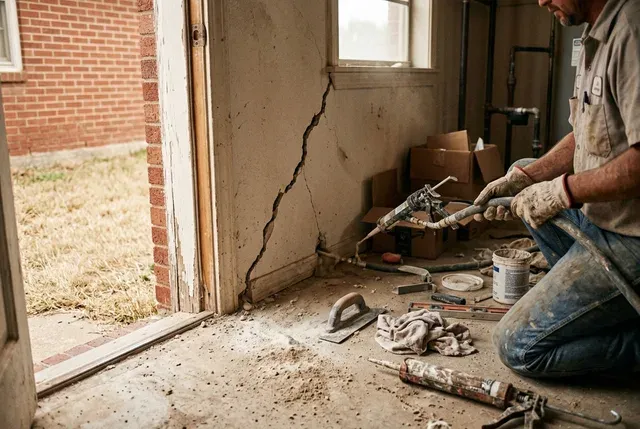
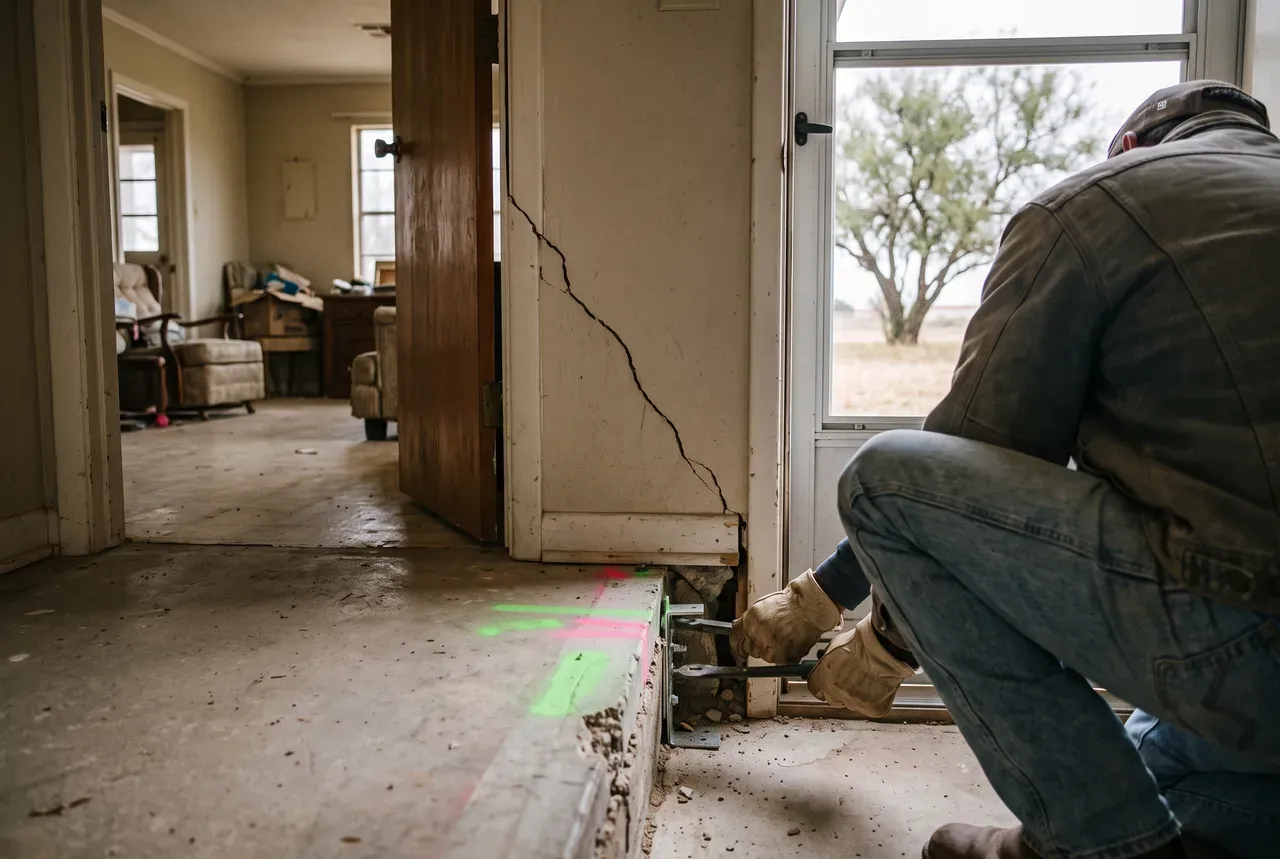
The crack pattern usually points the way. Edge settlement produces stair-step cracks in exterior brick near corners, gaps opening at the top of door frames on outside walls, and doors that bind at the top. Center heave produces cracks that run across interior floors, doors that bind at the bottom, and a visible hump you can feel walking through the middle of the house. The manometer survey confirms it by mapping the whole slab: a bowl shape means the edges settled, a dome means the center rose. The fix follows: perimeter piers and lift for settlement, moisture control and sometimes selective interior piering for heave.
Tunneling vs slab penetration for interior piers
When the center of a slab has dropped and needs support, interior piers reach it one of two ways.
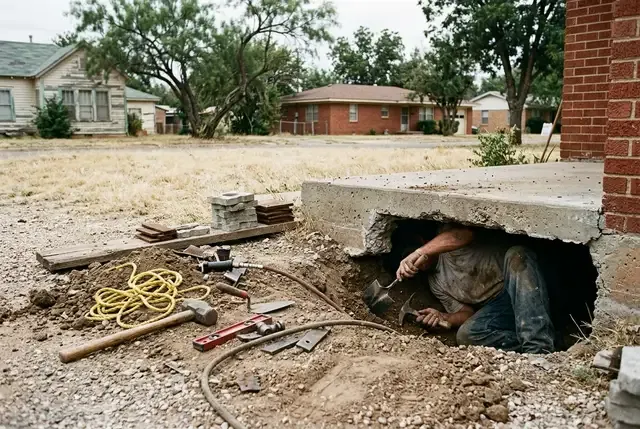
Hand-tunneling runs a small access tunnel under the slab from an exterior pit, and the crew places piers along the interior load-bearing lines without touching the floor inside. Your flooring, cabinets, and finishes are undisturbed. It costs more and adds a day or two because the tunnel is dug and backfilled by hand.
Slab penetration cores through the floor inside at each pier location, places the pier, and patches the opening. It is faster and cheaper, but it disturbs whatever flooring is there, and tile or hardwood over the core locations has to be dealt with.
Neither is wrong. On a home with new tile or wood floors, tunneling usually pays for itself. On a slab under carpet or in a house being renovated anyway, penetration is the practical choice. We price both at the survey so the decision is yours.
Plumbing under a repaired slab
On any Abilene slab home more than about 30 years old, the plumbing gets tested before piers go in. A static hydrostatic test isolates the drain system and watches for a drop that indicates a leak under the slab. This matters because a leak feeding water into the clay is often the reason the slab moved, and piering over an active leak means the movement continues and the repair is spent twice.
Older homes here often have cast-iron drain lines, and some 1960s and 70s houses have Orangeburg (bituminized fiber) sewer laterals that fail with age. If the test finds a leak, the line is repaired first, usually by a licensed plumber, and then the foundation work proceeds. Skipping the test to save a few hundred dollars on a home this age is a false economy, which is why it is written into the scope rather than offered as an add-on.
Insurance and payment
Slab movement from expansive soil is excluded on standard Texas policies. If a hydrostatic test finds a plumbing leak under the slab, the leak repair and some resulting damage may be covered. We run the test and document the result.
Standard Texas homeowners policies exclude foundation movement caused by expansive soil. Where a covered event is involved — most often a plumbing leak under a slab — we document the cause with photos and, on older homes, a static hydrostatic test, so an adjuster has what they need. We also work with third-party financing for larger scopes; ask at the inspection.
What's included
- Manometer survey of the full slab and a map of the settled and heaved zones
- Exterior and interior crack mapping tied to the elevation readings
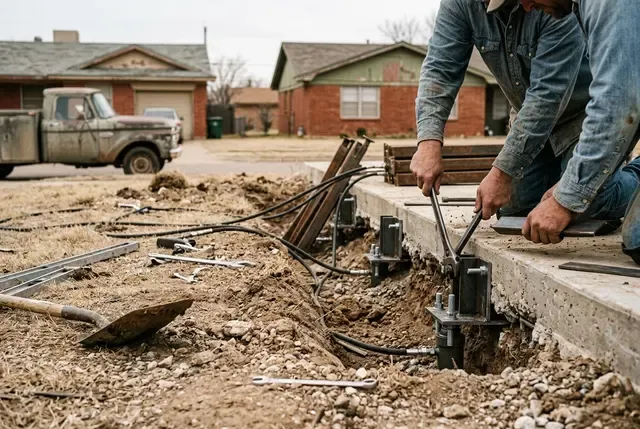
- Perimeter pier installation, steel or belled concrete, at the load points
- Interior pier support by tunneling or slab penetration where the center has dropped
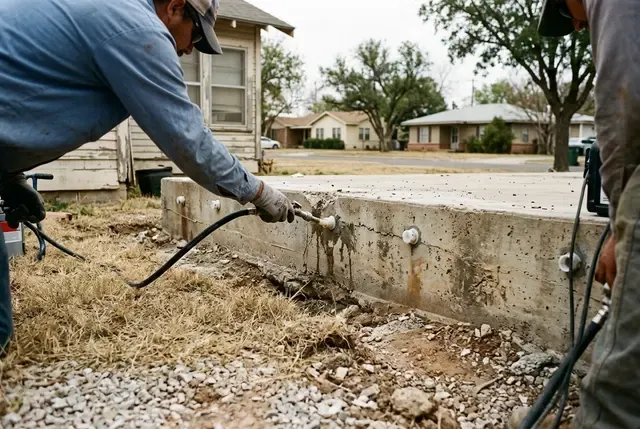
- Polyurethane deep injection to fill soil voids and re-seat the slab
- Synchronized lift to recover elevation within a safe tolerance
- Patching of access penetrations and backfill of exterior pits
- Elevation log, pier log, and the written workmanship warranty
DIY vs low bid vs done properly
| What matters | DIY / handyman | Lowest bid | Done properly |
|---|---|---|---|
| Finding the real cause | Guesswork from a YouTube video; no elevation data | Skips the manometer survey; quotes a flat pier count | Manometer survey maps the whole floor before a plan is drawn |
| Pier depth on clay | Not applicable — surface fixes only | Short piers that float in the active moisture zone | Piers seated below the seasonal moisture zone, depth logged |
| Plumbing under the slab | Ignored | Ignored; repair fails when the leak keeps feeding the soil | Hydrostatic test on older homes before and after the lift |
| What you're left with | Cracks return in one season | No elevation record, warranty vague or verbal | Before/after elevations, pier log, written workmanship warranty |
Our 4-step process
- 01
First call and booking
Give us the crack locations and the age of the home. We schedule the on-site survey, usually within 2 to 3 business days.
- 02
Slab survey
A technician surveys the slab, maps every crack, and determines whether the center, the perimeter, or both have moved, and in which direction.
- 03
Pier and injection work
Perimeter piers go in first, interior support follows by tunneling or penetration, and polyurethane fills the voids the clay left behind.
- 04
Lift and verification
The system is lifted together to a safe tolerance, elevations are re-surveyed, penetrations are patched, and you get the documentation.
Real jobs