Foundation Stabilization in Abilene, TX: Underpinning Methods, Costs & Which Ones Are Permanent
Last updated: October 2026
Foundation stabilization in Abilene, TX means permanently transferring your home’s load past the area’s notoriously unstable Sagerton and Tarrant clay — using underpinning piers seated below the active moisture zone — so the foundation stops moving regardless of West Texas drought and rain cycles.
Key Takeaways
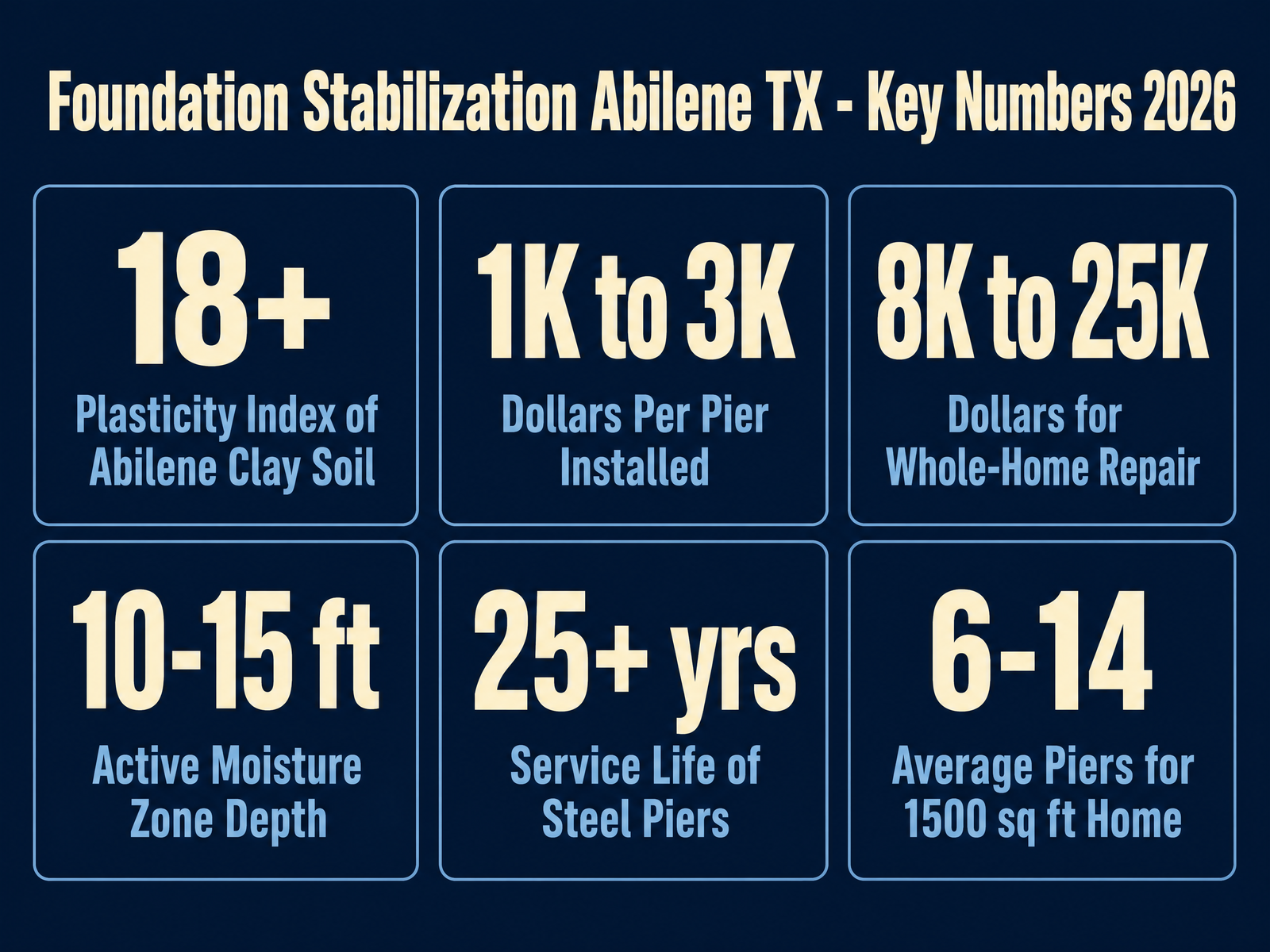
- Abilene’s clay soil has a plasticity index of 18 or higher, making it among the most expansive in Texas — the root cause of most local foundation movement. (Signs guide)
- Underpinning is a specific form of foundation repair: it relocates the foundation’s bearing point from shallow, unstable clay to deeper, stable ground via concrete or steel piers — not the same as surface lifting or crack patching.
- Bell bottom piers offer the best combined settlement and uplift resistance for Abilene’s dual-cycle clay — the only common method that actively resists both downward settling and upward heave.
- Steel push piers reach 20–80 feet deep and install faster, making them the stronger pick when settlement is dominant and a deep bearing stratum is needed.
- Individual piers typically cost $1,000–$3,000 installed; a whole-home project (6–14 piers) runs $8,000–$25,000. (Full cost guide)
- A building permit is required from the City of Abilene before stabilization work begins — a reputable contractor pulls it for you.
- Properly engineered underpinning piers are expected to last 25 years or more; the repair is considered permanent for the piered sections of the foundation.
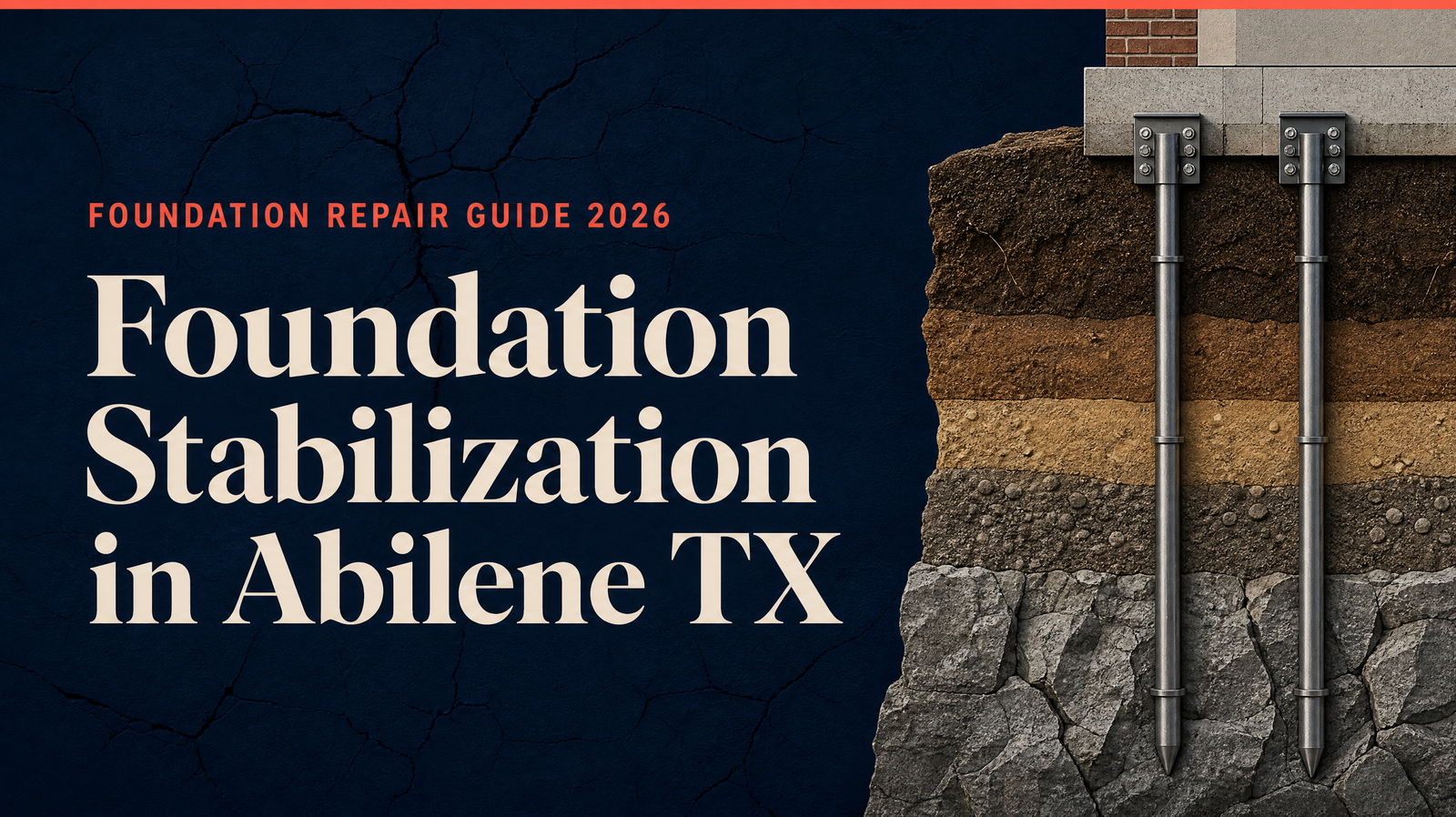
What is foundation stabilization, and why does Abilene specifically need it?
Foundation stabilization is any engineered repair that halts active foundation movement and restores the structure to a safe, load-bearing condition. It differs from cosmetic repairs — filling cracks, shimming sticking doors — in that it addresses the underlying cause: the soil beneath the footing can no longer reliably hold the building’s weight.
Abilene sits on Sagerton and Tarrant clay soils with a plasticity index of 18 or higher. Expansive clay this reactive shrinks and swells as moisture content changes, and that movement can translate into several inches of vertical displacement at the surface. As local foundation specialist John Laurence of B&B House Leveling explained to KTXS News Abilene: “The moisture, whether we have it or we don’t, plays with that clay so it expands and contracts.”
The droughts of 2011 and 2022–2023 each triggered a wave of new foundation problems across Taylor County. When the Big Country bakes for months, the active moisture zone — the 10-to-15-foot band of clay that regularly cycles wet and dry — shrinks away from footings, leaving them unsupported. Foundation stabilization piers bypass that zone entirely, seating in the stable stratum below where seasonal moisture changes have no measurable effect.
What does “underpinning” actually mean?
Underpinning is a specific structural repair used when an existing foundation must transfer its load to wider, deeper, or stronger support. According to Dalinghaus Construction, underpinning “moves the bearing point of your foundation from shallow, unstable soil to deep, competent ground” — the key distinction from surface-level repairs.
Foundation repair is the broader category. Underpinning is one of the most common methods within it, alongside concrete leveling, crawl space repair, and drainage correction. When Abilene homeowners or real estate agents say a home has been “stabilized,” they almost always mean the footing was underpinned with piers.
The process as described by Angi’s structural repair guide involves three core steps: (1) exposing the footing by excavation, (2) installing piers or supports that transfer the load downward, and (3) hydraulically lifting and locking the foundation at its target elevation. A manometer elevation survey before work confirms where movement has occurred and how many piers are needed.
One critical point: underpinning stabilizes the structure but does not fix the source of soil change on its own. If a plumbing leak has been saturating the soil under one corner, or if drainage is directing water toward the foundation, those issues must be corrected alongside any pier installation or the stabilization will not hold long-term.
What are the main foundation stabilization methods available in Abilene?
Five stabilization methods are used in the Abilene market. Two are considered truly permanent for the piered sections; the others serve narrower use cases or provide only temporary relief.
Bell Bottom Piers (Belled Concrete Piers)
A bell bottom pier is a poured concrete shaft with a wide, bell-shaped base cast below the active moisture zone. The bell spreads the load across stable soil AND mechanically resists upward clay heave — the dual-resistance feature that makes this method the recommendation of many structural engineers for expansive clay like Abilene’s Sagerton series. Shafts are hand-dug or machine-excavated, reinforced with full-depth steel rebar cages, and poured as one continuous monolithic column with no joints. Curing takes 3–5 days before synchronized hydraulic lifting begins.
Best for: homes where clay heaving (upward movement) occurs alongside settlement; pier-and-beam structures; properties where a structural engineer specifically recommends concrete underpinning. See the bell bottom pier cost guide for a full pricing breakdown.
Steel Push Piers (Hydraulic Push Piers)
Steel push piers are galvanized steel pipe sections driven hydraulically through the clay layer until they reach a stable bearing stratum, sometimes 20 to 80 feet below grade in West Texas conditions. A steel bracket bolted under the footing transfers the home’s weight onto the pier immediately — no cure time required. Push piers install faster and reach far deeper than concrete options, making them the stronger choice when the stable bearing layer sits well below the reach of practical excavation and settlement (not heave) is the primary problem.
Pier depth is determined by hydraulic pressure readings at each location, not a pre-set target. Any contractor promising “piers to 12 feet” without a site survey should be treated with caution. Best for: slab foundations with significant differential settlement; fast-install situations. Compare both options in detail at bell bottom piers vs. steel piers.
Concrete Pressed Piers (Pressed Pilings)
Short segments of precast concrete are hydraulically pressed into the ground using the home’s weight as downward resistance. These install faster and cost less than cast-in-place options but seat at shallower depths (typically 6–10 feet) and offer poor uplift resistance. On Abilene’s reactive clay, structural engineers often prefer bell bottom piers. Pressed piers may still be appropriate for lighter structures or tight access areas where excavation is impractical.
Concrete Leveling and Polyurethane Foam Lift
Mudjacking pumps a grout slurry under sunken concrete; polyjacking uses expanding polyurethane foam. Both work at the surface — they do not seat below the active moisture zone and do not qualify as underpinning. Concrete leveling is the right solution for sunken driveways, walkways, and detached slabs. Under a building foundation on Abilene clay, results are considered temporary by most licensed engineers.
Which stabilization method is the most permanent for Abilene’s clay soil?
Bell bottom piers and steel push piers are both considered permanent solutions for the sections of foundation where piers are installed. The right choice depends on the pattern of movement your specific home shows.
According to PermaPier’s soil selection guide, poured concrete bell bottom piers are preferred by many structural engineers for expansive clay precisely because they resist uplift — the upward force that push piers handle less effectively during heavy-rain wet cycles. Push piers excel at reaching deep stable strata quickly, which matters when no stable layer exists within the practical reach of hand excavation.
An important caveat: underpinning permanently stabilizes only the sections where piers are installed. Un-piered areas of the slab can still move if moisture conditions change dramatically, which is why a full-perimeter design typically outperforms spotting a handful of piers on a single corner. A thorough foundation inspection with a complete elevation survey is the essential starting point.
| Method | Settlement | Uplift | Depth | Cost / Pier | Cure Time | Permanence |
|---|---|---|---|---|---|---|
| Bell Bottom Piers | Excellent | Excellent | 8–12 ft | $1K–$3K | 3–5 days | Permanent |
| Steel Push Piers | Excellent | Moderate | 20–80 ft | $1K–$3K | None | Permanent |
| Pressed Concrete Piers | Good | Poor | 6–10 ft | $500–$1.5K | None | Conditional |
| Mudjacking / Poly Lift | Temporary | None | Surface | $500–$1.5K | None | Temporary |
| Soil Injection / Grouting | Variable | Poor | Shallow | Varies | 24–48 hrs | Temporary |
How much does foundation stabilization cost in Abilene, TX?
Individual piers — both bell bottom and steel push — typically run $1,000 to $3,000 each installed in the Abilene market. A typical single-family home needs 6 to 14 piers depending on footprint, soil conditions, and the extent of movement. That puts most whole-home projects in the $8,000 to $25,000 range, consistent with statewide benchmarks from Dalinghaus Construction’s Texas cost overview.
Several factors push costs higher:
- Interior tunneling — required when interior slab sections need piers but cannot be accessed from the perimeter; adds $1,000–$3,000 or more per tunnel location
- Drainage correction — poor grading or missing gutters is a common root cause; failing to fix it means piers underperform over time
- Plumbing repairs — leaking pipes under the slab saturate soil and must be addressed before or alongside underpinning
- Pier count and depth — more piers and greater driving depth each add directly to the total bill
- Commercial structures — commercial foundation repair typically involves heavier loads, engineered drawings, and more piers per linear foot
Use the foundation repair cost estimator to get a rough ballpark before scheduling an on-site visit, then review the complete Abilene foundation repair cost guide for a breakdown by repair method and home size.
What does the foundation stabilization process look like, step by step?
The general workflow for pier-based underpinning in Abilene follows four stages regardless of which pier type is chosen:
- Inspection and elevation survey. A manometer is used at grid points across the entire floor to map every high and low spot. This confirms that movement is active, identifies the worst-affected corners and sides, and determines pier count and placement. This survey is what separates proper underpinning design from guesswork.
- Engineering and design. Pier quantity, spacing, and type are finalized based on the elevation data, load-bearing calculations, and soil profile. Some projects require a licensed structural engineer’s stamp; jobs above a certain scope trigger Abilene’s permit requirement in any case.
- Pier installation. For bell bottom piers: shafts are excavated, reinforcement cages lowered, concrete poured continuously in one session. For steel push piers: brackets are bolted to the footing, then steel sections are driven with a hydraulic ram while pressure readings are logged at every location. Those pressure readings are the proof that each pier has reached competent bearing material.
- Synchronized lift and verification. Hydraulic jacks at each pier location are pressurized simultaneously to transfer the home’s weight onto the new piers and recover elevation where structurally safe. Excavations are backfilled, the grade is restored, and a post-lift elevation reading documents the outcome. Interior cracking and door binding typically ease in the weeks after lifting as the structure settles into its new supported position.
The same four-stage flow applies to both slab foundations and pier-and-beam structures, though pier-and-beam jobs also involve shimming and sistering beams during the lifting phase. House leveling services combine underpinning with frame correction in one scope of work.
Do you need a permit for foundation stabilization in Abilene?
Yes. The City of Abilene Building Inspections Department requires a permit whenever work involves the structural repair of a building, which includes all pier-based underpinning. The department is at 555 Walnut St, Abilene TX 79601, reachable at (325) 676-6232, Monday through Friday 8:30 AM–5:00 PM.
A reputable contractor pulls the permit on your behalf before work starts. Never agree to skip the permit — an un-permitted repair can complicate resale, void manufacturer warranties on pier hardware, and make it harder to transfer a workmanship warranty to a future buyer. For the full requirements, see the Abilene foundation repair permit guide.
Get a Free On-Site Foundation Inspection in Abilene
Every inspection includes a full manometer elevation survey and a written scope. No commitment required to proceed.
Schedule Your Free Inspection →Frequently asked questions about foundation stabilization and underpinning in Abilene
What is foundation stabilization in Abilene, TX?
Foundation stabilization is any repair that stops an Abilene foundation from moving further and restores it to safe load-bearing condition. In practice this almost always means underpinning the footing with concrete or steel piers that bypass the expansive Sagerton and Tarrant clay — not patching cracks or shimming doors, which address symptoms rather than the underlying soil problem.
Is underpinning the same as foundation repair?
Not exactly. Foundation repair is the broad category covering all repair types. Underpinning is one specific method within it — the one that transfers the foundation’s bearing point from shallow, unstable soil to deeper, stable ground. Drainage correction, concrete leveling, and crawl space encapsulation are other foundation repair methods but they are not underpinning and do not provide the same structural load-bearing support.
How long does foundation stabilization last in Abilene?
Properly engineered bell bottom piers and steel push piers have expected service lives of 25 years or more — the piers are effectively permanent. Future movement at un-piered sections remains possible if moisture cycles continue or if the root cause (drainage, plumbing) is not corrected alongside the piering. That’s why the full scope of work matters as much as pier type.
Do bell bottom piers or steel push piers work better in Abilene clay?
Bell bottom piers offer superior combined settlement and uplift resistance, making them the top structural engineering recommendation for Abilene’s dual-cycle clay that moves both down and up. Steel push piers reach deeper and install faster and are the stronger pick when settlement is the dominant issue and a deep stable bearing layer is needed. The right answer requires a site-specific elevation survey — not a blanket recommendation. See the full comparison guide.
How much does foundation stabilization cost in Abilene, TX?
Individual piers run $1,000 to $3,000 each installed in the local market. A whole-home project using 6 to 14 piers typically costs $8,000 to $25,000. Jobs requiring interior tunneling, drainage correction, or plumbing repairs can exceed this range. Use the cost estimator for a rough starting range and the Abilene cost guide for a full method-by-method breakdown.
Do I need a permit for foundation stabilization in Abilene?
Yes. The City of Abilene Building Inspections Department requires a building permit for structural foundation repair. A reputable contractor pulls it on your behalf before work begins. Skipping the permit can create problems at resale, void pier hardware warranties, and complicate workmanship warranty transfers to future owners.
Can foundation stabilization fix my sloping floors?
Underpinning can recover measurable elevation where structurally safe, which usually reduces floor slope noticeably. Not every inch of historical settlement can be reversed once the structure has adjusted to its settled position — attempting too much lift can crack walls or damage finishes. Your contractor should use the pre-work elevation survey to establish realistic recovery targets before any lifting begins.
What is the active moisture zone in Abilene clay soil?
The active moisture zone is the depth of soil that regularly expands and contracts with seasonal rainfall and drought. In Abilene’s Sagerton and Tarrant clay, this zone typically extends 10 to 15 feet below grade. Stabilization piers must seat below this zone to avoid being pushed or pulled by seasonal clay movement — which is why surface-level methods like mudjacking are not a substitute for true underpinning when the foundation itself is moving.